
Most companies lose momentum because their best thinking cannot get through the organization.
The strategy is understood in the room, but not in the field. The portfolio makes sense to leadership, but not to the channel. The value proposition is clear in the deck, but not in the sales conversation. The customer experience is discussed as a priority, but not built into the moments where choice, confidence, and conversion happen.
This is where brand problems become business problems.
This article is part of Branding Strategy Insider’s FREE newsletter. Join the world’s smartest marketers and subscribe here for actionable insights delivered directly to your inbox.
They show up as margin pressure, slow growth, weak conversion, channel confusion, inconsistent execution, stalled innovation, and a company that is harder to buy from, harder to sell for, and harder to value.
For mid-market companies, this matters. They rarely have the luxury of waste. They compete against larger enterprises with more resources and smaller challengers with fewer constraints. They need every strategic choice to create leverage.
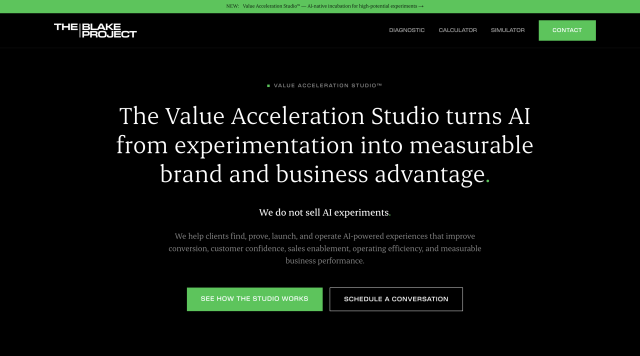
That is the context for The Blake Project’s Value Acceleration Studio.
The Studio is a human-led, AI-enabled offering designed to help leadership teams solve organizational problems through the lens of brand. It helps identify, prototype, launch, and scale brand-driven experiences with the potential to create measurable business value.
The purpose is not to make brand strategy faster for the sake of speed. It is to make brand strategy more useful to the business.
The Cost Of Brand Drag
Brand drag is the gap between what a company has decided strategically and what the business can actually execute.
- It is visible when sales teams explain the company differently.
- It is visible when customers cannot determine which product, service, or brand is right for them.
- It is visible when channel partners do not understand the full value of the portfolio.
- It is visible when marketing, sales, product, finance, and operations make decisions from different assumptions.
- It is visible when leadership knows what needs to change, but the organization lacks the tools, experiences, and systems to effect behavior change.
Brand drag is expensive because it slows the business at the very points where value is created.
The Value Acceleration Studio is designed to reduce that drag.
Scenario 1: A Manufacturer With A Portfolio The Market Cannot Navigate
A mid-market manufacturer may have strong products, respected brands, and meaningful channel relationships. But when the portfolio becomes difficult to understand, the business loses leverage.
A retailer may not know which brand to lead with. A distributor may not understand where margin opportunity lives. A sales representative may default to the most familiar product rather than the best-fit solution. A customer may struggle to connect product choice with lifestyle, performance, price, design, or durability.
The Studio could create a portfolio navigation experience that helps sales teams, channel partners, and customers understand which brand is right for which customer, channel, price point, design need, and project type.
It could also create a “right product, right customer” selling experience that matches needs to solutions while reinforcing the distinct role of each brand.
The outcome is more than improved messaging. It is clearer selling, better product fit, stronger channel confidence, reduced portfolio confusion, and greater enterprise value.
Scenario 2: A University With A Strong Yet Disconnected Story
Many universities have a brand platform. Fewer have a system that helps admissions, advancement, alumni relations, faculty, athletics, and communications use it consistently.
The result is fragmentation. Different teams tell different versions of the institution’s story. Donor conversations become disconnected from enrollment priorities. Alumni engagement becomes episodic. The brand promise stays at the institutional level rather than becoming useful in daily decisions.
The Studio could create a brand storytelling system that translates the strategy into practical use cases.
Admissions teams could tailor messages for prospective students and parents. Advancement teams could connect donor interests to institutional impact. Alumni teams could personalize engagement by school, life stage, affinity, and career path. Communications teams could evaluate whether new initiatives strengthen or dilute the brand.
The outcome is a more disciplined institutional voice, stronger enrollment narratives, better donor conversations, and greater consistency across the university.
Scenario 3: A Healthcare Organization Trying To Turn Trust Into Action
Healthcare organizations often compete on similar promises: care, compassion, expertise, access, and community commitment.
The challenge is not to claim trust. The challenge is to operationalize it.
Patients need help choosing the right pathway. Referring physicians need confidence in the organization’s capabilities. Employees need to understand what the brand promise means in moments of stress. Service lines need clearer differentiation.
The Studio could create a patient decision experience that guides people to the right care pathway while reinforcing the organization’s distinctive promise.
It could also create a referral-confidence platform for physicians or an internal brand-behavior system that helps frontline teams understand how the brand should be experienced.
The outcome is stronger trust, clearer service-line differentiation, better referral confidence, and a more direct connection between brand promise and patient experience.
Scenario 4: A B2B Technology Company With A Product Buyers Do Not Fully Value
Many technology companies have strong capabilities but weak executive relevance.
The product may work. The business case may not.
A CFO wants to understand economic impact. A CIO wants to understand risk, integration, and security. An operating leader wants to understand productivity. A commercial leader wants to understand conversion, speed, or customer experience.
When the value proposition does not translate across decision-makers, sales cycles slow, and pricing pressure increases.
The Studio could create a buyer-value experience that converts technical capabilities into role-specific business outcomes.
Instead of explaining features, the company can help each decision-maker see the value in the language of their function.
The outcome is sharper sales enablement, faster buyer understanding, improved executive relevance, and stronger confidence in the purchase decision.
Scenario 5: A Government Organization Trying To Turn Public Purpose Into Public Understanding
Government organizations often carry significant public value, but that value can be difficult for citizens, partners, funders, and internal teams to understand.
Programs may be fragmented. Services may be hard to navigate. Public communications may emphasize process over outcomes. Internal departments may define success differently. Citizens may not know where to go, what to do, or why the organization matters.
The Studio could help create a public value experience that makes services, priorities, and outcomes easier to understand and act on.
A city, county, agency, or public authority could use this kind of experience to help residents navigate services, understand major initiatives, access resources, or see how public investment connects to community outcomes. Internally, the same system could help departments evaluate communications, programs, and partnerships against a clearer brand promise and public mission.
The outcome is greater public trust, clearer service navigation, more consistent communications, stronger stakeholder alignment, and a more useful connection between public purpose and daily experience.
For government organizations, brand value is created when people understand what is available, why it matters, and how to engage.
Scenario 6: A Consumer Brand That Needs To Convert Meaning Into Behavior
A consumer brand may have awareness, affinity, or emotional relevance, yet still struggle to convert.
The issue may be choice complexity, weak retail storytelling, unclear product architecture, poor education, or a gap between brand meaning and customer action.
The Studio could create a guided customer experience that connects shopper need states, lifestyle priorities, product benefits, usage occasions, and brand meaning.
A food brand could guide customers by health goals, family routines, taste preferences, or meal occasions. A home-goods brand could help customers envision product fit. A personal care brand could help shoppers navigate regimen, preference, price, and desired outcome.
The outcome is improved conversion, stronger basket building, clearer differentiation, and a more direct line between brand equity and revenue.
Scenario 7: A Private Equity-Backed Company Preparing For The Next Stage Of Value Creation
Private equity-backed companies often face a familiar challenge: the operating model has improved, but the growth story is still unclear.
The company may have acquired brands, expanded channels, added capabilities, or entered new markets. But the market may not understand the platform. Employees may still operate from legacy assumptions. Customers may see a collection of offerings rather than a coherent enterprise.
The Studio could create an enterprise value narrative, portfolio decision system, sales enablement experience, or brand-to-EBITDA decision tool that helps leadership connect brand strategy to value creation.
The outcome is sharper strategic clarity, better integration, stronger commercial discipline, and a more compelling story for customers, employees, investors, and future buyers.
In this context, brand should make the business easier to understand, easier to believe in, and more valuable.
From Strategy To Working Assets
The Value Acceleration Studio follows a practical sequence.
First, identify the business problem that brand can help solve.
Second, determine where value is most likely to be created.
Third, prototype the experience, tool, or system quickly.
Fourth, launch it in a focused environment where learning can happen fast.
Fifth, measure what works and scale the ideas with the strongest business case.
The format depends on the problem. It may be a sales experience, a customer decision guide, a portfolio navigation system, an executive diagnostic, a brand governance tool, a channel confidence platform, a public value experience, or an enterprise value narrative.
The point is not to build more things.
The point is to build the right things.
Brand should strengthen competitive position, pricing power, and enterprise value. The Blake Project helps make that happen.
Brand Needs Mechanisms, Not More Language
Many companies do not need another articulation of who they are.
They need mechanisms that help people choose, sell, explain, evaluate, prioritize, and act.
That is where brand strategy becomes commercially useful.
A strong brand creates meaning. A valuable brand converts meaning into behavior. A more valuable company converts behavior into measurable business outcomes.
For mid-market leaders, this is the opportunity.
Brand can improve sales productivity. It can support pricing power. It can reduce internal ambiguity. It can increase customer confidence. It can sharpen portfolio decisions. It can improve conversion. It can help a company compete on a new level.
But only when it moves from presentation to application.
The companies that win will be the ones that make brand easier to use, easier to buy, easier to sell, and easier to value.
The Blake Project’s Value Acceleration Studio helps leadership teams turn brand strategy into working assets that solve business problems and create measurable value.
Learn More
If your leadership team is facing a growth, conversion, retention, pricing, portfolio, or alignment problem that brand may be able to solve, The Blake Project’s Value Acceleration Studio can help identify what is limiting growth and determine what is worth building.
Schedule a conversation with The Blake Project to explore whether the Value Acceleration Studio is right for your organization.
At The Blake Project, we help leaders turn brand into a disciplined driver of financial performance — strengthening pricing power, competitive position, and enterprise value. Email us to start a conversation about enduring profitable growth. For The EBITDA.
Branding Strategy Insider is a service of The Blake Project, a strategic brand consultancy focused on turning brand into pricing power, growth, and enterprise value.